
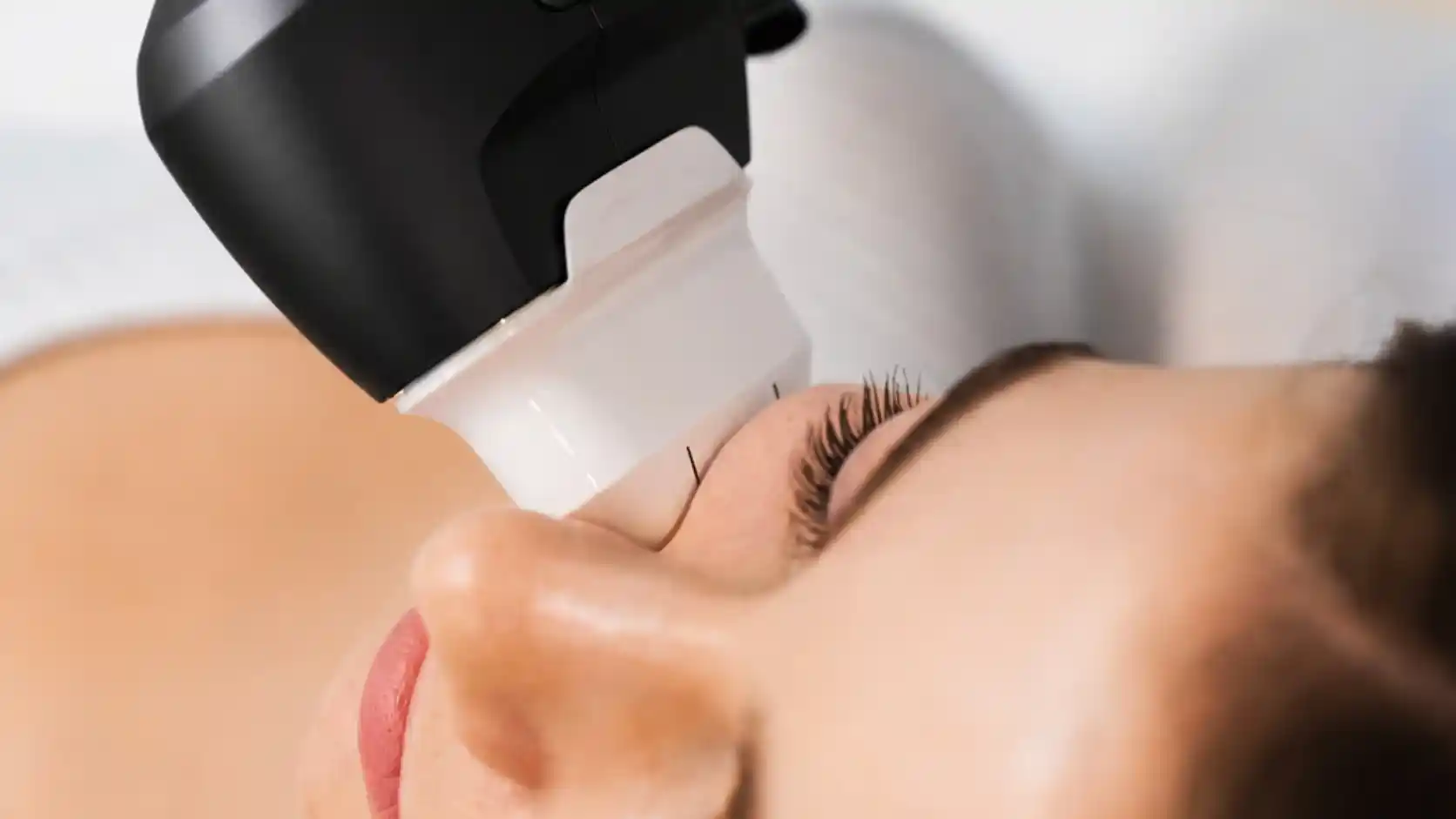
If you are considering a HIFU facial, knowing what happens before, during and after your treatment can make the experience feel clearer and more considered. Your journey should begin with an in-person consultation, continue with a treatment planned around your facial anatomy and finish with personalised aftercare and appropriate follow-up.
HIFU is non-invasive, but it is still a professional aesthetic procedure. It is not suitable for everyone, results cannot be guaranteed and temporary reactions can occur. At Skin by Ale Müller in Cascais, safety comes before treatment, and every recommendation begins with understanding the person behind the skin.
First, what is a HIFU facial?
HIFU stands for High-Intensity Focused Ultrasound. In aesthetic practice, focused ultrasound energy is directed beneath the skin’s surface to create a controlled response in selected tissue layers. This may support collagen remodelling and progressive improvement in the appearance of firmness and definition.
There are no incisions or injections. However, “non-invasive” does not mean risk-free or universally suitable. Facial anatomy, skin condition, health history, previous aesthetic procedures and the area being considered all matter. This is why a consultation is part of the treatment itself, not an administrative step before it.
For a fuller introduction to the technology and the difference between treatment areas, explore our HIFU Facial in Cascais page.
HIFU Facial at a glance
| Stage | What you can expect |
|---|
Before
A personalised consultation, review of relevant health information and recent procedures, facial assessment and preparation guidance.
During
Skin preparation, individual planning of the agreed treatment area and focused ultrasound delivered while your comfort is monitored.
After
Personalised aftercare, possible temporary redness, swelling, tenderness or altered sensation, and gradual rather than instant change.
Before your HIFU facial treatment
1. Your consultation comes first
Every skin has a unique history. Ageing, sun exposure, lifestyle, sensitivity, previous procedures and natural facial structure all influence what you see in the mirror — and how your skin may respond to treatment.
During your consultation, Ale Müller, facial aesthetics specialist, will take time to understand:
What has changed from your perspective
Which features you want to preserve
Your expectations and what a natural-looking result means to you
Your current skin condition and degree of visible laxity
The relationship between your face, jawline, area beneath the chin and neck
Relevant health information, medication and recent or planned procedures
If HIFU is considered appropriate, Ale will explain whether a focused HIFU – Face treatment or the more continuous HIFU – Face & Neck approach is relevant to your concerns. A larger treatment area is not automatically a better one. The right scope depends on professional assessment.
Sometimes the safest and most honest recommendation is to postpone HIFU, request medical clearance or consider that another approach may be more appropriate.
2. What you should tell the Facialist
Complete and accurate information is essential. Before treatment, tell Ale Müller if any of the following may apply to you:
Pregnancy or breastfeeding
An active infection, cold sore, inflammation, wound, burn or significant irritation in the area
An implanted electronic device, metal implant or stent
Medication that affects bleeding or healing, or any recent change in medication
A history of abnormal scarring, altered sensation or relevant health conditions
Recent fillers, threads, injectables, laser, peel, surgery or another aesthetic procedure
A recent or planned medical or dental procedure that may affect treatment timing
This is not a self-screening checklist, and it is not exhaustive. Do not stop prescribed medication in preparation for HIFU unless the healthcare professional responsible for it tells you to do so. Suitability and timing must be assessed in person.
3. How to prepare
Your own instructions may differ according to your skin and treatment plan, so the guidance provided directly by Skin by Ale Müller always takes priority.
General preparation may include:
Avoiding intense sun exposure and arriving without sunburn or active irritation
Avoiding aggressive skin treatments close to the appointment
Telling the clinic about every recent aesthetic or medical procedure in the area
Arriving with clean skin if requested
Following any personalised instructions given after your consultation
Avoid making last-minute changes to your skincare or concealing a new reaction because you do not want to postpone the appointment. A delay is preferable to proceeding when the skin or your health history needs to be reassessed.

What happens during a HIFU facial?
1. Your skin and treatment area are reassessed
2. What HIFU may feel like
3. How long does the appointment take?
What to expect after HIFU
Immediately afterwards
Many people are able to return to ordinary activities relatively soon, but this should not be interpreted as an absence of possible reactions.
-
Redness or warmth
-
Mild swelling
-
Tenderness or a bruised feeling
-
Sensitivity in the treated area
-
Tingling or temporary numbness
-
Occasional bruising
The type, intensity and duration of these responses vary. Your skin may look relatively unchanged immediately after the appointment, and that does not indicate whether the biological response will develop. HIFU is not designed as an instant transformation.
Your HIFU aftercare
Aftercare should be simple, gentle and specific to you. Follow the written or verbal instructions provided by Skin by Ale Müller, even if general online advice differs.
-
Use daily sun protection and avoid intense sun exposure
-
Keep the skin comfortably hydrated
-
Avoid saunas, very hot baths and excessive heat during the initial period
-
Keep skincare gentle and pause aggressive products if instructed
-
Avoid rubbing, irritating or unnecessarily manipulating the treated area
-
Postpone other aesthetic procedures in the area until the clinic confirms that it is appropriate
If you are uncertain about exercise, skincare actives, make-up or another treatment after your appointment, ask the clinic. The correct timing depends on your skin’s response and the procedure being considered.
When to contact the studio
Most expected responses are temporary, but unusual or severe symptoms should never be dismissed. Contact Skin by Ale Müller promptly if you experience intense or increasing pain, a burn or blister, severe swelling, persistent numbness, marked asymmetry or another reaction that concerns you.
Visual symptoms or significant neurological symptoms require urgent medical assessment. If you are unsure whether a reaction is expected, contact the studio rather than waiting or trying to treat it yourself.
Rare but relevant complications have been reported in the scientific literature, including burns, prolonged altered sensation, nerve irritation, pigment change, tissue changes and scarring. Appropriate client selection, anatomical knowledge, professional training and careful technique are central to reducing risk, but no aesthetic procedure can be described as entirely risk-free.
When will you see a difference?
HIFU works through a gradual tissue response. Some clients may notice an early sense of firmness, while more meaningful visible changes, when they occur, tend to develop progressively over the following weeks and months as collagen remodelling takes place.
The timing and degree of change vary with age, skin quality, facial anatomy, the area treated, lifestyle and individual biological response. Results cannot be guaranteed, and one person’s photographs should never be used as a promise of another person’s outcome.
We will explore this process in greater depth in our next Journal article: When Do HIFU Results Appear? Understanding the Collagen Timeline.
Ale Müller’s approach: precision begins with understanding
At Skin by Ale Müller, the purpose of a HIFU consultation is not to persuade every client to proceed. It is to understand the face as a whole, identify what can reasonably be supported and recognise when treatment should not go ahead.
Ale’s work with international clients in Portugal also acknowledges that every skin arrives with a different history: climate, phototype, sun exposure, sensitivity, lifestyle and previous care all shape the treatment conversation. The objective is never to standardise the face or chase an exaggerated change. It is to pursue considered, progressive and natural-looking refinement when HIFU is appropriately indicated.
What happens during your consultation
The official service includes a one-hour assessment, professional evaluation, 3D facial imaging, a personalised three-month treatment plan, homecare recommendations and an individual digital document.
Is a HIFU facial painful?
Sensation varies. Some clients experience warmth, tingling, prickling or deeper tenderness during treatment. It is more accurate to discuss possible discomfort than to promise a painless experience. Ale will explain what you may feel and monitor your comfort throughout the appointment.
Is there downtime after HIFU?
Many clients return to their usual routine relatively soon. Temporary redness, swelling, tenderness, tingling, numbness or bruising can occur, however, and individual recovery varies. Follow your personalised aftercare rather than assuming that “minimal downtime” means no reaction.
What should I avoid before a HIFU facial?
General guidance may include avoiding intense sun exposure and aggressive skin treatments close to the appointment. You must also disclose medication, health conditions, implants and recent procedures. The clinic’s personalised pre-treatment instructions take priority.
Can I have HIFU after fillers, threads, laser or a peel?
Do not decide timing from a generic online interval. The type of procedure, treatment area, date, current skin condition and professional responsible all matter. Tell Ale about all recent and planned procedures so compatibility and timing can be assessed safely.
How do I know whether HIFU – Face or HIFU – Face & Neck is right for me?
You do not need to choose alone. HIFU – Face focuses on facial concerns, while HIFU – Face & Neck considers the transition between the face, jawline, area beneath the chin and neck. The appropriate area is confirmed only after an in-person assessment.
Begin with a personalised facial assessment
Understanding what to expect is valuable. Understanding whether HIFU is appropriate for your skin, anatomy, history and goals is essential.
Book a personalised facial assessment with Ale Müller at Skin by Ale Müller in Cascais. Together, you can explore your concerns, set realistic expectations and decide whether HIFU – Face, HIFU – Face & Neck or a different approach is the most considered next step.
Source notes / reference suggestions
These sources support the educational explanation of focused ultrasound, gradual outcomes, temporary effects, evidence limitations and the importance of professional selection and technique. They should not be used to promise an individual result.
Haykal D, Sattler S, Verner I, et al. A Systematic Review of High-Intensity Focused Ultrasound in Skin Tightening and Body Contouring. Aesthetic Surgery Journal. 2025. PubMed
Ayatollahi A, Gholami J, Saberi M, et al. Systematic review and meta-analysis of safety and efficacy of high-intensity focused ultrasound (HIFU) for face and neck rejuvenation. Lasers in Medical Science. 2020. PubMed
Contini M, et al. A Systematic Review of the Efficacy of Microfocused Ultrasound for Facial Skin Tightening. International Journal of Environmental Research and Public Health. 2023. Full text
Humphrey VS, Rambhia PH, Gmyrek R. Microfocused Ultrasound With Visualization: A Systematic Review of Adverse Events and Risk of Subsequent Facelift Compromise. Dermatologic Surgery. 2025. PubMed
Friedmann DP, Bourgeois GP, Chan HHL, et al. Complications from microfocused transcutaneous ultrasound: Case series and review of the literature. Lasers in Surgery and Medicine. 2018. PubMed
Compliance review
No treatment suitability is recommended by chat.
No result, lift, wrinkle reduction or number of sessions is guaranteed.
No surgical-equivalence or risk-free language is used.
No device settings, cartridges, energy levels, treatment depths or shot counts are disclosed.
Common temporary reactions and rare but relevant risks are not minimised.
Clinic-specific preparation and aftercare take priority over general guidance.
Alessandra Müller is positioned as a facial aesthetics specialist, not a medical doctor.
The article introduces the results timeline without duplicating the planned second article.
